


Are you looking for a high-intensity workout that can transform your body in no time? Look no further than the humble jump rope. This simple, yet effective tool has been a staple of childhood playgrounds and boxing gyms for decades, but has recently gained popularity among fitness enthusiasts and athletes.
A jump rope workout is an excellent way to improve cardiovascular health, boost bone density, and burn calories. In just 15 minutes of jumping, you can burn 200-300 calories. Our comprehensive fitness plan will guide you from beginner to advanced levels, helping you transform your body through progressive training.
Key Takeaways
- Discover the transformative power of jump rope workouts for your body.
- Learn how to progress from beginner to advanced levels with our comprehensive plan.
- Understand the benefits of incorporating jump rope into your existing fitness regimen.
- Find out how to burn 200-300 calories in just 15 minutes with jump rope training.
- Get an overview of what to expect from our complete fitness plan.
The Remarkable Benefits of Jump Rope Training
Engaging in jump rope training can lead to substantial improvements in cardiovascular health, muscle strength, and overall coordination and agility. This form of exercise is not only efficient but also offers a wide range of benefits that can enhance overall physical fitness.

Cardiovascular Health Improvements
Jump rope training is an excellent cardiovascular exercise that improves heart health by increasing heart rate and blood flow. Regular jumping rope can help lower blood pressure, improve circulation, and enhance overall cardiovascular function. This reduction in cardiovascular risk factors can lead to a longer, healthier life.
Full-Body Muscle Engagement
Jump rope is a full-body exercise that engages multiple muscle groups simultaneously, including the legs, core, and arms. The repetitive motion of jumping rope strengthens these muscles, improving overall muscle tone and endurance. As a result, individuals can expect to see improvements in their overall strength and physical fitness.
Coordination and Agility Enhancement
The rhythmic motion of jump rope training requires timing and precision, enhancing coordination and agility. By practicing jump rope, individuals can improve their hand-eye coordination, footwork, and overall neuromuscular connection. This improvement in coordination and agility can translate to better performance in other sports and daily activities, reducing the risk of falls and injuries.
Choosing the Right Jump Rope for Your Fitness Goals

To get the most out of your jump rope workout, it’s essential to choose a rope that aligns with your fitness goals. The right jump rope can make a significant difference in your training, whether you’re looking to improve cardiovascular health, increase endurance, or build strength.
Different types of jump ropes cater to various fitness objectives. Understanding these differences is crucial in making an informed decision.
Speed Ropes for High-Intensity Workouts
Speed ropes are designed for high-intensity workouts, making them ideal for those looking to improve their cardiovascular health and burn calories. These ropes are typically lightweight and feature a smooth, fast rotation mechanism, allowing for quick and efficient workouts.
Weighted Ropes for Strength Building
Weighted ropes are perfect for those looking to build strength and endurance. The added weight provides an extra challenge, engaging your muscles more intensely and helping you achieve your strength-building goals.
Beaded Ropes for Beginners
Beaded ropes are a great option for beginners, as they provide a more forgiving and rhythmic experience. The beads help to maintain a consistent rotation speed, making it easier to time your jumps and develop your technique.
Cordless Options for Limited Space
Cordless jump ropes are an excellent solution for those with limited space or a preference for a tangle-free experience. They’re perfect for indoor workouts or confined areas, offering more portability and ease of use. The weighted handles simulate the feel of a conventional rope, making them an excellent alternative.
When choosing a jump rope, consider your fitness goals, available space, and personal preferences. By selecting the right rope, you can optimize your workout routine and achieve better results.
Mastering Proper Jump Rope Form
Effective jump rope training hinges on mastering the correct form and technique. While it’s normal to feel a certain level of discomfort when starting a new workout regimen, it’s essential to listen to your body and differentiate between good and bad pain. If you experience sharp, persistent pain, stop exercising and rest.
Correct Posture and Body Alignment
Maintaining the correct posture is vital when jumping rope. Keep your back straight, shoulders relaxed, and core engaged. Imagine a string pulling your head up towards the ceiling, keeping your body in alignment. This posture helps in maintaining balance and ensures that you’re using the correct muscles.
Wrist and Arm Positioning
The movement of the rope is generated primarily by the wrists, not the arms. Keep your elbows close to your body and your forearms parallel to the ground. The wrists should be relaxed, with a subtle motion that propels the rope over your head and under your feet. Avoid using too much arm and shoulder movement, as this leads to quicker fatigue.

Foot Placement and Jumping Technique
Your feet should be shoulder-width apart, with your weight on the balls of your feet. Jump about 1-2 inches off the ground, using your calf muscles to propel yourself upward. Land softly on the balls of your feet to reduce impact. Avoid landing flat-footed or on your heels, as this increases impact forces and joint stress.
Common Form Mistakes to Avoid
Beginners often make several mistakes that can hinder their progress and increase the risk of injury. Here are some common errors to watch out for:
- Jumping too high, which wastes energy and can throw off your timing.
- Using excessive arm movement instead of efficient wrist rotation.
- Hunching shoulders or looking down at feet, disrupting proper form and balance.
- Improper rope length, which can affect your timing and form.
- Landing flat-footed or on heels, increasing impact forces and joint stress.
To avoid these mistakes, focus on maintaining proper form and technique. Adjust your rope length, improve your timing, and maintain proper body position to enhance your jumping rope experience.
Essential Safety Tips for Jump Rope Workouts
Jump rope workouts can be an exhilarating way to improve your fitness, but safety must not be overlooked. To get the most out of your exercise routine while minimizing the risk of injury, it’s essential to consider several safety factors.
Choosing the Right Surface
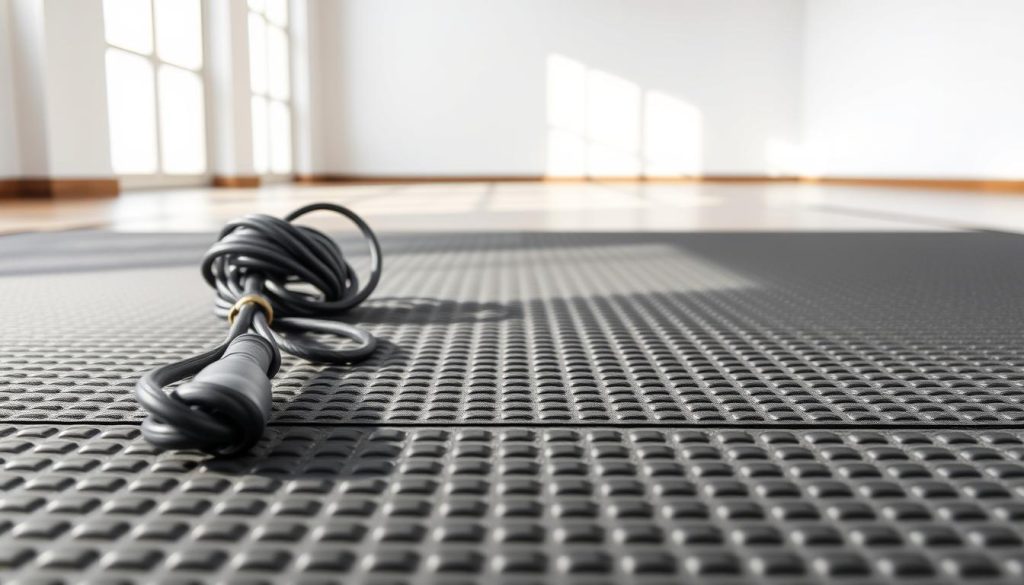
The surface you choose for your jump rope workout significantly impacts your safety and the effectiveness of your exercise. Avoid hard surfaces like concrete, as they can be harsh on your joints. Instead, opt for a surface that provides some give, such as a wooden floor or a rubber mat. This can help reduce the impact on your joints and lower the risk of injury.
Appropriate Footwear and Clothing
Wearing the right footwear and clothing is crucial for a safe and comfortable jump rope workout. Choose shoes that are designed for high-impact activities, with good arch support and cushioning to absorb the impact of jumping. Clothing should be comfortable and not too loose, as it could get caught in the rope. Opt for breathable fabrics to keep you cool during your intense workout.
- Select shoes with good arch support.
- Wear comfortable, fitted clothing.
- Choose breathable fabrics for better ventilation.
Warming Up and Cooling Down Properly
Warming up before and cooling down after your jump rope workout is essential to prepare your muscles, heart, lungs, and nervous system for the exercise and aid recovery afterward. Start your warm-up with light cardio, such as jogging in place, followed by dynamic movements targeting your calves, quads, hamstrings, and shoulders. After your workout, cool down with a slower activity like walking, followed by some light stretching to gradually lower your heart rate and begin the recovery process.
- Begin with light cardio to increase blood flow.
- Incorporate dynamic stretches to prepare your muscles.
- Cool down with walking and light stretching to aid recovery.
The Complete Jump Rope Fitness Plan
Our comprehensive jump rope fitness plan is tailored to help you achieve remarkable fitness gains over 8 weeks, incorporating various techniques and intensity levels. This structured program is designed to progressively challenge your endurance, strength, and agility, ensuring a well-rounded workout experience.
Week 1-2: Building Foundation and Technique
The initial two weeks focus on establishing a solid foundation in jump rope technique and building initial endurance. Start with basic jumps, gradually increasing the duration as you become more comfortable. Aim for 3 sessions per week, with each session lasting 15-20 minutes. Incorporate rest days to allow your body to recover and adapt.
Sample Workout: Begin with 3 minutes of continuous jumping, followed by 1 minute of rest. Repeat for a total of 15-20 minutes. As you progress, increase the continuous jumping time by 1-2 minutes each session.
Week 3-4: Increasing Endurance and Introducing Variations
By weeks 3-4, you’ll start to notice improvements in your endurance and technique. It’s time to introduce variations to keep the workouts engaging and challenging. Incorporate alternate foot jumps, high knees, and double unders into your routine. Increase your workout frequency to 4 times a week, with at least one day of rest in between.
Example Routine: Warm up with 2 minutes of basic jumps. Then, alternate between 1 minute of high knees and 1 minute of regular jumps for 15-20 minutes. Cool down with 2 minutes of stretching.
Week 5-6: Adding Intensity and Complex Movements
As you enter weeks 5-6, you’ll be ready to increase the intensity and complexity of your workouts. Introduce more advanced techniques such as crossover jumps and boxer steps. Your workout sessions should now last 25-30 minutes, with 4-5 sessions per week.
Advanced Workout: Start with a 5-minute warm-up. Then, perform 3 sets of 3 minutes of double unders followed by 1 minute of rest. Incorporate strength training exercises like squats and push-ups during rest periods to enhance overall fitness.
Week 7-8: Advanced Combinations and HIIT Integration
The final weeks of the program integrate advanced jump rope techniques with high-intensity interval training (HIIT) for maximum fitness gains. You’ll learn complex combinations like double unders, crossover variations, and boxer steps, significantly increasing workout intensity.
HIIT Protocol: Warm up with 5 minutes of light cardio. Then, alternate between 1 minute of maximum intensity jump rope (e.g., double unders) and 30 seconds of rest. Repeat for 20-25 minutes. Cool down with 5 minutes of stretching. This protocol optimizes both aerobic and anaerobic fitness.
To further enhance your workout, combine advanced jump rope movements with bodyweight exercises like burpees, mountain climbers, and squat jumps. Monitor your workout intensity through perceived exertion and heart rate to ensure you’re working at the appropriate level for your fitness goals.
Beginner Jump Rope Workout Routines
Beginner jump rope workout routines are designed to help newcomers develop the fundamental skills and endurance needed for more advanced training. If you’re new to jump rope workouts, start with the basics. This beginner workout focuses on mastering the fundamental technique and building endurance.

The Basic 10-Minute Starter Workout
The Basic 10-Minute Starter Workout is an excellent introduction to jump rope exercise. It involves 5 minutes of continuous jumping followed by 5 minutes of active recovery, such as marching in place or light stretching. This routine helps beginners get accustomed to the rhythm and motion of jumping rope.
To make the most of this workout, focus on maintaining a steady pace and proper form. As you become more comfortable, you can gradually increase the duration of your jumping intervals.
Alternating Foot Technique Practice
Alternating Foot Technique Practice is crucial for improving coordination and rhythm. This exercise involves alternating feet as you jump, mimicking the motion of running. Start with short intervals of 20-30 seconds, followed by 30 seconds of rest.
As you build confidence and coordination, you can extend the duration of your alternating foot jumps. Remember to keep your knees slightly bent and your core engaged to maintain balance and control.
Endurance-Building Circuit for Newcomers
The Endurance-Building Circuit for Newcomers is a comprehensive circuit-style workout designed to enhance endurance through a combination of rope work and active recovery exercises. This structured format alternates between 20-30 seconds of basic jump rope and complementary low-impact exercises like marching in place.
- Begin with 20-30 seconds of jump rope, focusing on maintaining a consistent rhythm.
- Follow with 30-40 seconds of marching in place or another low-impact exercise to allow for partial recovery.
- Repeat the circuit for 10-15 minutes, adjusting the intervals based on your fitness level.
- As your endurance improves, gradually reduce the non-jumping intervals to increase the intensity.
Proper breathing techniques and pacing strategies are essential for maintaining consistent energy throughout the circuit and avoiding early burnout. Practice deep, rhythmic breathing to support your workout and help you stay focused.
Intermediate Jump Rope Workout Routines
Take your jump rope skills to the next level with these intermediate workout routines tailored for fitness enthusiasts. At this stage, you’re expected to have a good grasp of the basic techniques and are ready to challenge yourself with more complex exercises and higher intensity workouts.
The Jack and Squat Combination Workout
This workout combines cardiovascular exercise with strength training. Start with a 5-minute warm-up of regular jump rope. Then, alternate between 30 seconds of “jack” jumps (a variation where you jump with your feet apart and together, like a jumping jack) and 30 seconds of squats. Repeat this cycle for 15-20 minutes, finishing with a 5-minute cool-down of stretching exercises. This routine not only improves your cardio but also strengthens your lower body.
Tabata-Style Jump Rope Intervals
Tabata is a high-intensity interval training (HIIT) protocol that can be applied to jump rope workouts for enhanced cardio benefits. Warm up for 5 minutes, then perform 20 seconds of all-out jump rope effort followed by 10 seconds of rest. Repeat this cycle for 4-6 rounds. Finish with a 5-minute cool-down. This workout routine is designed to boost your metabolism and improve your anaerobic capacity.
30-Minute Full Body Jump Rope Circuit
For a comprehensive full-body workout, try this 30-minute circuit. The circuit involves 60 seconds of jump rope intervals alternated with 30-45 seconds of strength exercises targeting major muscle groups. For example, you could do 60 seconds of jump rope followed by 30 seconds of push-ups, then 60 seconds of crossover jumps followed by 30 seconds of bodyweight rows. Continue this pattern for 30 minutes, ensuring you cover exercises that work on push, pull, squat, hinge, and core movements. This circuit not only improves your cardiovascular fitness but also enhances your muscular endurance.
To track your progress with these workout routines, monitor the number of rounds you complete, your recovery time, or your ability to maintain proper jump rope technique throughout the circuit. Adjust the intensity and volume of your workouts based on your progress to continue challenging yourself.

Advanced Jump Rope Workout Routines
Elevate your fitness journey with advanced jump rope workout routines that test your endurance and skill. These challenging exercises are designed to push your limits and help you achieve new heights in your fitness journey.
The Fighter’s Jump Rope Routine
The Fighter’s Jump Rope Routine is a high-intensity workout that mimics the training regimens of professional boxers. This routine involves 30 seconds of high-intensity jumping followed by 30 seconds of rest. Repeat for 15-20 minutes, incorporating various techniques such as alternating footwork and double unders.
Double Under Challenge Workout
The Double Under Challenge Workout is designed to improve your speed and coordination. Start with 3 sets of 10 double unders, resting for 30 seconds between sets. As you progress, increase the number of double unders and reduce rest time. This workout is an excellent way to enhance your jump rope technique and endurance.
Skipmaggedon: The Ultimate Jump Rope Test
Skipmaggedon is the ultimate test of jump rope mastery, combining advanced techniques, endurance, and mental fortitude in one comprehensive challenge. This intense workout consists of:
- Criss cross jump – 45 seconds. Rest – 15 seconds.
- Backwards jump – 45 seconds. Rest – 15 seconds.
- Alternate foot criss cross – 45 seconds. Rest – 15 seconds.
- Mummy kicks – 45 seconds. Rest – 15 seconds.
- Double under – 45 seconds. Rest – 15 seconds.
- Rest 2 minutes.
To complete this challenge successfully, focus on proper pacing and mental focus techniques. Make adjustments to your form as needed, especially when fatigue sets in. A scoring system can be used to measure performance and track improvements over time.
Incorporating Jump Rope into Your Existing Fitness Routine
Jump rope training is a versatile exercise that can be seamlessly integrated into your existing fitness regimen. By incorporating jump rope workouts, you can add variety to your routine, boost cardiovascular fitness, and enhance overall athletic performance.
As a Warm-Up Before Strength Training
Using jump rope as a warm-up before strength training can prepare your muscles for the upcoming workout. A 5-10 minute jump rope session can increase blood flow, raise your heart rate, and activate your muscles, making your strength training more effective.
For Active Recovery Between Workout Days
Jump rope can also be used for active recovery on rest days or between intense workout sessions. Low-intensity jump rope workouts can help promote blood circulation, aid in muscle recovery, and maintain cardiovascular fitness without putting excessive strain on your muscles.
Combining with Other Cardio Activities
Combining jump rope with other cardio activities like running, cycling, or rowing can create a more comprehensive cardiovascular training program. For example, you can alternate between jump rope intervals and running sprints or cycle between jump rope and rowing machine exercises. This multi-modal approach can help reduce repetitive stress, improve overall athletic capacity, and keep your workouts interesting.
- Sample workout format: Alternate between 3 minutes of jump rope and 3 minutes of running for a total of 20 minutes.
- Benefits include improved cardiovascular fitness, increased calorie burn, and enhanced muscular endurance.
- To balance intensity, start with lower-intensity cardio activities and gradually increase the intensity as you progress.
Conclusion
The jump rope is more than just a simple childhood toy; it’s a powerful tool for achieving your fitness goals. Jump rope workouts provide an excellent cardio session, improving cardiovascular health and endurance. They also enhance coordination and agility, engaging your legs, core, arms, and shoulders in a full-body workout.
Our progressive eight-week jump rope fitness plan systematically builds skills from beginner to advanced levels, improving overall fitness and transforming your body. This training plan is adaptable to any fitness level and can be incorporated into existing routines. With proper equipment, technique, and consistent practice, you can unlock the full potential of jumping rope as a comprehensive exercise regimen.
By embracing jump rope as a core part of your workouts, you’ll not only transform your body but also experience the numerous benefits of this efficient and effective exercise. So, grab a rope and start your journey towards a fitter, healthier you with a well-structured plan.